



Check the quality of your flour using the broken starch analysis.
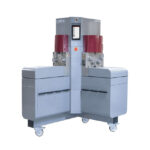
The CHOPIN Technologies SDmatic 2 (second generation) is a simple and accurate instrument for measuring broken starch in flours for the milling and confectionery industries. It is a fully automated, enzyme-free analyzer that produces reliable results for measuring broken starch using just one gram of flour in as little as 10 minutes. is based on the amperometric method (Medcalf & Gilles).
It is officially recognized internationally and meets industry standards. Partially digested starch is naturally produced during the milling process and directly affects the properties and functionality of the flour. SDmatic 2 helps mills ensure that they produce flours that meet their customers’ specifications. For the secondary processing industry, it is a cost-effective tool for quality control of raw materials.
Features
Fully automated enzyme-free analysis based on the amperometric reference method of Medcalf & Gilles.
Results in 10 minutes. Only 1 gram of flour is needed per test. Results are available in various units of measurement (AI%, Choipan-Dubois units, AACC 76-31 equivalents, Farrand—alternative enzymatic methods).
Built-in software that enables data storage and the development of new protocols.
Export data to a USB drive (.csv) or via a network to a LIMS (using a script).
Network connection for maintenance via TeamViewer.
Complies with international standards: NF EN ISO 17715:2015, ICC 172, AACC 76-33.01.
The results obtained with SDmatic 2 are comparable to those obtained using enzymatic methods. Therefore, it is possible to develop custom calibrations and install them on the instrument.
Related Products

CHOPIN Albograph
CHOPIN Technologies offers solutions to
measure the consistency of a dough, its extensibility, and its
its elasticity as well as the
its performance during baking.
Use in the grain industry
For Grain Traders
For Flour Mills
- Ensure the purchase and sale of wheat and flour using international benchmarks.
- Check the quality of the grain upon delivery
- Select and record the grains according to their intended use
- Check the wheat for damage caused by insect infestation
- Optimization of wheat and flour blends
- You tailor the flour to its intended use by carefully adding additives and improvers
- Check the various flour samples
- Use in durum wheat (Triticum durum): semolina protocol (Standard UNI 10453)
For the Bakery Industry
- Ensure that the flour you receive is of the proper quality
- Try out new combinations
- Check the ingredients

Rheo F4 CHOPIN TECHNOLOGIES
The rheofermentometer allows for the assessment of flour maturation potential and yeast activity. It measures the growth of the dough during the proofing process. To do this, the device simultaneously records three curves:
- the rising of the dough
- the rate of CO2 diffusion and the amount produced
- the volume of CO2 trapped in the dough.

MIXOLAB 2 CHOPIN TECHNOLOGIES
The Mixolab2 device measures the characteristics of the dough during mixing
and the quality of the starch and protein.
It is the essential tool that provides comprehensive information on the characteristics of
flours and an indication of their expected behavior during kneading and
baking.
The device evaluates the dough’s consistency during continuous mixing while gradually increasing the temperature. With a single test, we obtain a comprehensive analysis of yeast behavior when it is cold (protein activity) and when it is heated (starch activity).
Mixolab complies with the ICC 173, AACC 54-60.01, and NF V03-765 standards
The software enables the development
of various protocols and profiles for
research and simulation related to the production line.
With the Simulator protocol, you can perform tests similar to those of
the Farinograph, yielding comparable results.
You can develop new recipes, check the effect of ingredients and
additives, and identify alternative uses for flour that does not meet
the required characteristics, based on its end use and the
production process (production line).